Industrial salt is not selected by purity alone. Particle size affects how salt flows, dissolves, blends and moves through industrial equipment. For buyers comparing industrial salt manufacturers in India, understanding mesh size can help prevent slow dissolution, uneven mixing, excess dust and inconsistent processing.
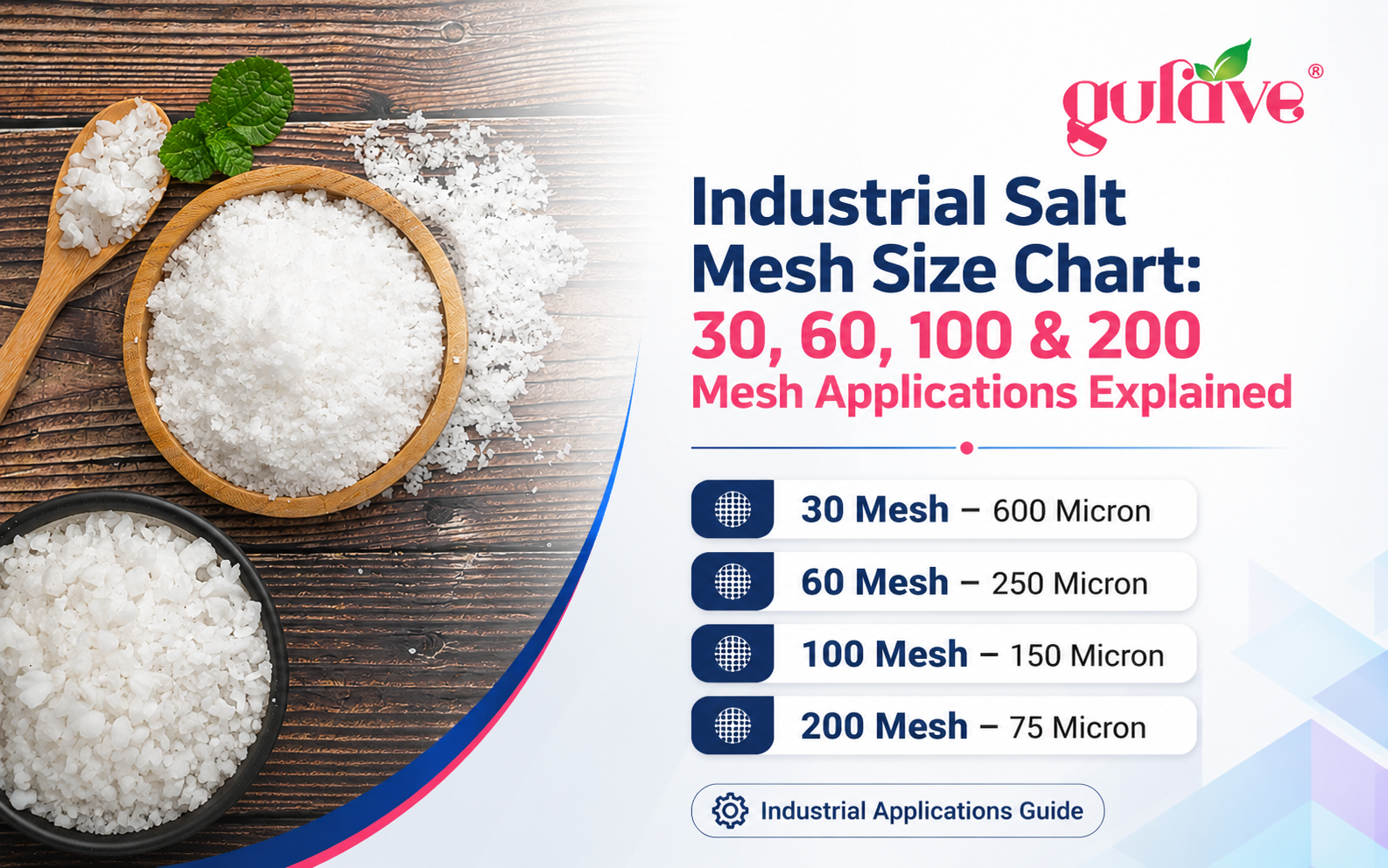
A mesh number describes the nominal fineness of a screened material. In general, a higher mesh number means a smaller sieve opening and a finer salt particle. The chart below uses common ASTM E11 nominal sieve openings as a practical reference. Actual particle-size distribution should always be confirmed through the supplier’s specification and Certificate of Analysis.
Industrial Salt Mesh Size Chart
| Mesh size | Nominal sieve opening | Practical grade | Common industry applications |
| 30 mesh | 600 microns | Coarse refined or medium-granule salt | Detergents, textiles, brine preparation and chemical manufacturing |
| 60 mesh | 250 microns | Medium-fine mesh salt | Dyeing, approved food processing, mineral blends and general chemical use |
| 100 mesh | 150 microns | Fine powdered salt | Dry blending, powdered detergents, seasoning blends and controlled formulations |
| 200 mesh | 75 microns | Ultra-fine salt powder | Specialty dry mixes, technical formulations and precision process applications |
These grade descriptions are practical commercial terms, not universal regulatory classifications. Mesh values are nominal, and the supplied product can contain particles above and below the stated opening.
What Does Mesh Size Mean in Industrial Salt?
Mesh size refers to the sieve used to classify particles. A 30-mesh screen has a larger opening than a 100- or 200-mesh screen. Therefore, 30-mesh salt is comparatively coarse, while 200-mesh material is much finer.
However, “30 mesh salt” does not mean that every crystal measures exactly 600 microns. A commercial grade is normally defined by a distribution, such as the percentage retained on one sieve and the percentage passing through another. Buyers should request a complete sieve analysis instead of relying on one mesh number.
Particle size influences:
- Dissolution speed in water or process liquor
- Flow through hoppers, feeders and dosing equipment
- Uniformity in powder or chemical blends
- Dust formation during handling
- Storage behaviour and caking risk
- Performance in automated production equipment
30 Mesh Salt: Coarse Refined Industrial Grade
Approximate Opening: 600 Microns
Thirty-mesh salt is suitable when an operation needs visible granules rather than powder. It generally produces less airborne dust than very fine salt and can work well where the material is dissolved before use or steadily fed into a production process.
Common applications include detergent production, textile processing, industrial brine preparation, chemical manufacturing and general-purpose blending.
The Gurave Salt home page refers to “refined Salt 30 Mash.” The technically correct expression is “Refined Salt 30 Mesh.” A complete purchasing specification should also state purity, moisture, insoluble matter, additives, packaging and the accepted sieve distribution.
60 Mesh Salt: Balanced Fineness and Handling
Approximate Opening: 250 Microns
Sixty-mesh salt is finer than 30 mesh but less powdery than 100- or 200-mesh material. This balance can support faster dissolution, more uniform mixing and easier metering through industrial equipment.
When evaluating industrial salt manufacturers in Gujarat, ask whether 60 mesh means material passing through a 60-mesh sieve, material retained within a defined range or a target median particle size. These definitions are not interchangeable.
Possible uses include textile dyeing, selected chemical processes, powdered cleaning products, mineral mixtures and food processing when the salt is produced and documented as food grade.
100 Mesh Salt: Fine Salt for Uniform Blending
Approximate Opening: 150 Microns
One-hundred-mesh salt offers good dispersion in dry formulations. It can be useful where coarse crystals would create an uneven blend or where relatively fast dissolution is needed.
Typical applications can include:
- Powdered detergent formulations
- Dry chemical blends
- Fine seasoning mixes when food-grade requirements are met
- Technical mixtures requiring consistent dispersion
- Controlled manufacturing processes using fine powders
Fine particles have a greater surface area relative to their mass, which supports rapid dissolution and distribution. The trade-off is that fine salt can create more dust, absorb moisture more readily and require improved humidity control.
200 Mesh Salt: Ultra-Fine Salt for Specialised Processes
Approximate Opening: 75 Microns
Two-hundred-mesh salt has a powder-like texture and can be considered for specialty dry blends, technical formulations, laboratory preparations and other closely controlled applications.
Not every production line can consistently supply 200-mesh salt. Ultra-fine grades can require additional grinding, classification, dust control and particle-size testing.
Gurave Salt’s published Mesh Salt information currently lists a granule range of 10 to 80 mesh, with customisation available according to industry requirements. Buyers requiring 100- or 200-mesh material should therefore discuss it as a custom specification and approve the product through samples and sieve-analysis reports.
Mesh Salt, Coarse Salt and Fine Salt: Key Differences
Although these product terms are sometimes used interchangeably, they describe different characteristics.

Mesh Salt
Mesh Salt is classified according to a stated sieve or particle-size range. It is suitable for processes where controlled granulation affects dissolution, mixing, flow or final-product consistency.
Coarse Salt
Coarse Salt contains larger crystals and is commonly used in water treatment, de-icing, chemical processing and textile production. Gurave Salt lists its coarse industrial grade at approximately 1 mm to 12 mm, making it substantially larger than 30-mesh material.
Fine Salt
Fine Salt is washed, dried and ground into smaller particles. Gurave Salt lists an approximate granule range of 0.1 mm to 1 mm for its fine industrial grade. Because this range can cover several sieve sizes, buyers should still define the required mesh distribution when requesting a quotation.
How to Choose the Correct Salt Mesh Size
The best mesh size depends on the equipment, manufacturing process and end-product requirement. Before placing a bulk order, provide the supplier with:
- Target mesh size or complete sieve distribution
- Required sodium chloride purity
- Maximum moisture level
- Maximum water-insoluble content
- Iodised or non-iodised requirement
- Intended industrial application
- Monthly quantity and delivery schedule
- Required bag size, liner and pallet format
- Certificate of Analysis or inspection requirements
A trial sample is especially important when salt will pass through automated feeders, narrow pipes, spray systems or high-speed powder mixers.
Buyers should also test how the salt behaves under actual production conditions. A laboratory sample can meet the stated mesh size but still perform differently because of moisture, crystal shape, storage conditions or the presence of fine particles.
Why Choose Gurave Salt?
Gurave Salt, operating as Shree Krishna & Co, is based in Gandhidham, Kutch, Gujarat and supplies industrial, mesh, coarse and fine salt for domestic and export requirements. The company offers graded products, multiple packaging formats, bulk supply capabilities and export logistics through major ports. This enables buyers to discuss particle size, purity, packaging and delivery as one complete supply specification.
Businesses comparing industrial salt manufacturing companies in India should select a supplier that can provide a clear specification, representative sample, batch documentation and dependable logistics. Gurave Salt supports industrial buyers with 25 kg, 35 kg and 50 kg packaging, customized requirements and bulk supply options.
Conclusion
Mesh size is a functional purchasing specification rather than just a product label. As the mesh number increases from 30 to 200, the nominal sieve opening decreases from approximately 600 to 75 microns.
This change can affect dissolution, blending, dust generation, equipment flow and storage behavior. Buyers should use the industrial salt mesh size chart as a starting point and then confirm the complete particle-size distribution, purity, moisture and process suitability before approving a bulk order.