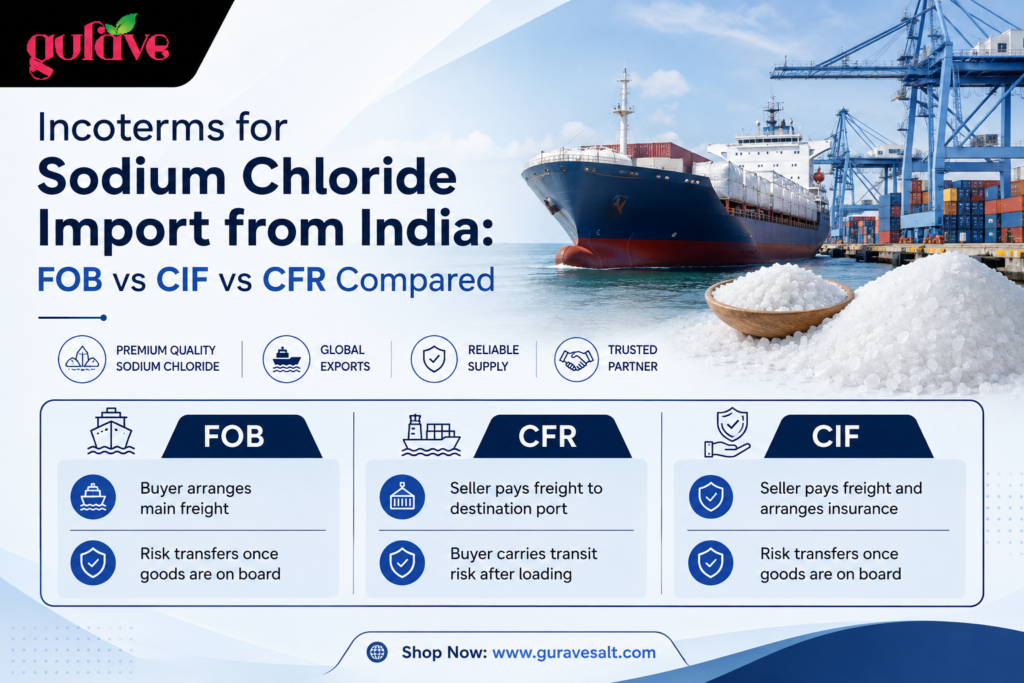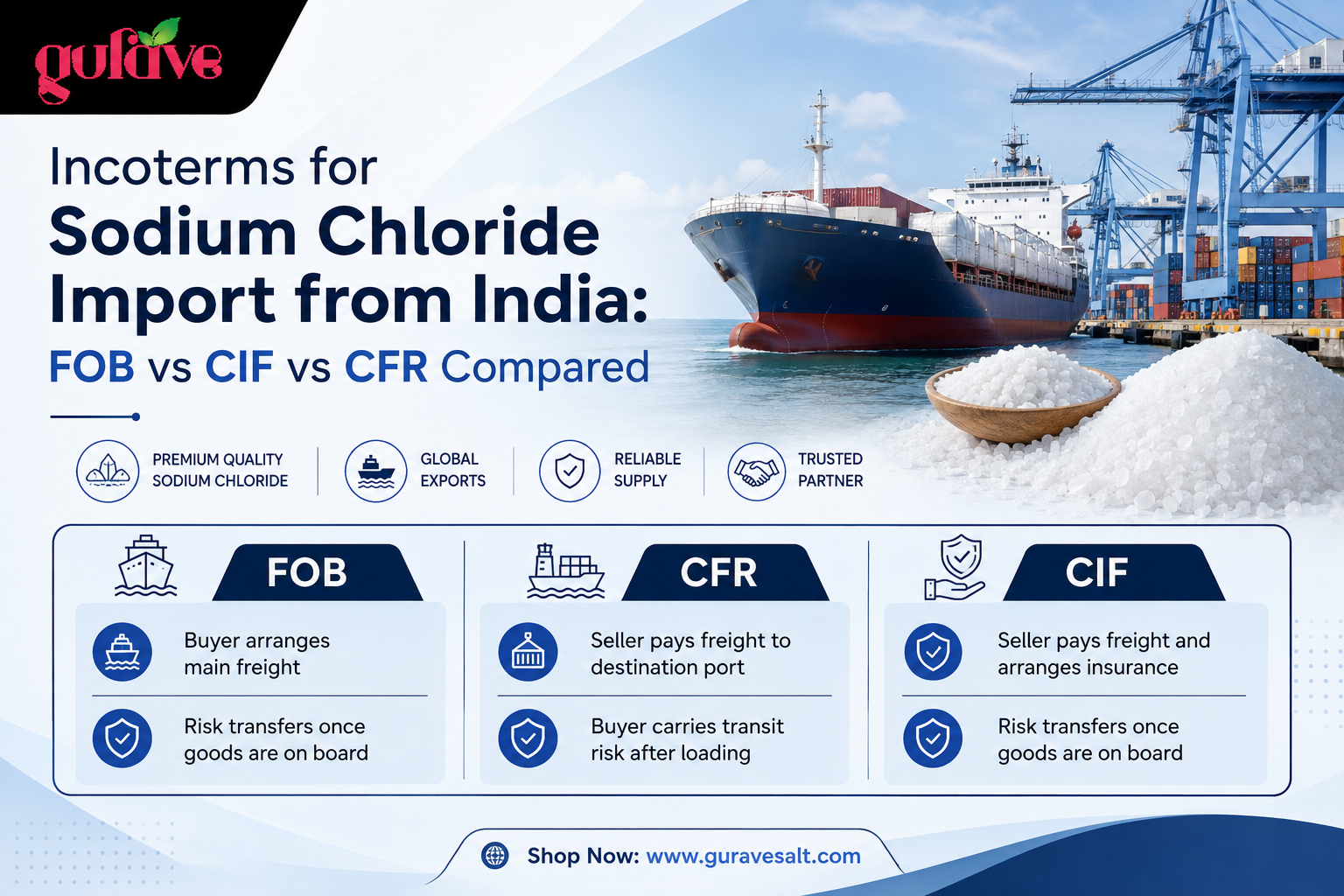
Importing sodium chloride in bulk involves more than agreeing on grade, purity, quantity and price. International buyers also need to decide who arranges transport, who pays freight, where risk transfers and whether marine insurance is included. These responsibilities are commonly defined through Incoterms rules.
For businesses planning a Sodium Chloride Import from India, understanding FOB, CFR and CIF can help prevent unexpected logistics costs and confusion between buyer and supplier. Each term allocates freight, risk and insurance differently, so the right option depends on the buyer’s shipping experience, destination and preferred level of control.
What Are Incoterms in Sodium Chloride Trade?
Incoterms are internationally recognised trade rules published by the International Chamber of Commerce. They clarify key responsibilities between sellers and buyers, including delivery, transportation-related costs and the point at which risk transfers.
For sodium chloride shipped by sea, FOB, CFR and CIF are frequently considered. However, an Incoterm does not replace the full sales contract. Buyers should still confirm specifications, payment terms, inspection requirements, shipment dates, documentation and destination-country import requirements.
A quotation should identify the selected Incoterm, the named port and the applicable version, such as Incoterms 2020.
FOB: Free On Board
Under FOB, the seller delivers the sodium chloride on board the vessel nominated by the buyer at the agreed port of shipment. Risk transfers from seller to buyer once the goods are on board.
Seller Responsibilities Under FOB
The seller generally handles:
- Production and agreed export packaging
- Inland movement to the named shipment port
- Export customs formalities
- Loading the cargo on board
- Required commercial and export documentation
Buyer Responsibilities Under FOB
The buyer generally handles:
- Main ocean freight
- Marine cargo insurance, if desired
- Import customs clearance
- Duties, taxes and destination-side delivery
- Other buyer-side charges under the contract
FOB often suits experienced importers that already work with freight forwarders or shipping lines. It gives the buyer more control over freight negotiation, carrier selection and insurance arrangements.
CFR: Cost and Freight
CFR means Cost and Freight. The seller arranges and pays the freight required to move the goods to the named destination port.
A common mistake is assuming that the seller carries the risk until the cargo reaches that port. Under CFR, risk transfers happen when the goods are placed on board the vessel at the port of shipment, even though the seller pays the ocean freight.
Why Choose CFR?
CFR may suit an importer that wants the exporter to organise sea freight but prefers to arrange marine insurance independently.
When comparing sodium chloride manufacturers in gujarat, asking for both FOB and CFR prices can make freight comparisons easier. The buyer can compare the supplier’s shipping rate with quotations from its own freight partners before selecting the most practical option.
Because CFR does not require the seller to purchase cargo insurance for the buyer, the importer should make appropriate insurance arrangements when protection is required.
CIF: Cost, Insurance and Freight
CIF means Cost, Insurance and Freight. As with CFR, the seller arranges and pays freight to the named destination port. The important difference is insurance: under CIF, the seller must also obtain the insurance cover required by the Incoterms rule for the buyer’s transit risk.
Risk nevertheless transfers when the goods are on board the vessel at the shipment port. CIF therefore should not be interpreted as meaning that the seller remains responsible for all transit risk until arrival.
When Can CIF Be Useful?
CIF can be convenient for buyers that prefer the supplier to arrange both ocean freight and the required marine insurance. This may be useful for occasional importers or businesses without established freight and insurance arrangements.
Buyers should still review the insurance terms. If broader cover is needed for a high-value or commercially sensitive shipment, any additional protection should be agreed before dispatch.
FOB vs CFR vs CIF: Quick Comparison
| Factor | FOB | CFR | CIF |
| Seller pays ocean freight | No | Yes | Yes |
| Seller arranges required marine insurance | No | No | Yes |
| Risk transfers on board at shipment port | Yes | Yes | Yes |
| Buyer controls main freight booking | Usually | Usually not | Usually not |
The cheapest quotation is not always the lowest landed cost. Buyers should compare freight, insurance, destination charges, customs costs, inland transport and handling fees before making a decision.
Which Incoterm Is Best for Sodium Chloride Imports?
There is no single best option for every transaction.
FOB May Suit Buyers Who:
- Already have competitive freight contracts
- Want to nominate the carrier or forwarder
- Prefer to arrange insurance themselves
- Regularly import bulk commodities
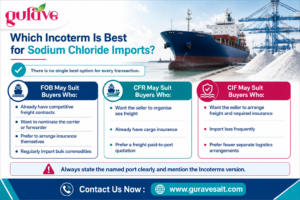
CFR May Suit Buyers Who:
- Want the seller to organise sea freight
- Already have cargo insurance
- Prefer a freight-paid-to-port quotation
CIF May Suit Buyers Who:
- Want the seller to arrange freight and required insurance
- Import less frequently
- Prefer fewer separate logistics arrangements
Whichever term is selected, the named port should be stated clearly. A vague term such as “FOB India” can create uncertainty. The contract should identify the specific port and Incoterms version.
What Importers Should Confirm Before Shipment
Incoterms define delivery responsibilities, but sodium chloride buyers must also control the technical and commercial details of the order.
Before approval, confirm:
- Sodium chloride grade and intended application
- Required NaCl purity and chemical parameters
- Moisture limits
- Particle or mesh size
- Packaging type and bag weight
- Order quantity and acceptable tolerance
- Certificate of Analysis requirements
- Third-party inspection, if required
- Loading and destination ports
- Production and shipment schedule
- Shipping and customs documents
- Incoterm and named port
- Payment terms
Clear specifications help prevent situations where the delivered salt meets a general description but does not suit the buyer’s manufacturing process.
Why Choose Gurave Salt for Sodium Chloride Export?
Gurave Salt supplies sodium chloride and industrial salt from Gujarat, India, for domestic and international requirements. Its product offering includes food-grade and industrial-grade sodium chloride, together with export packaging options for bulk orders. The company also supports overseas supply through experience in export documentation, bulk shipments and port-based logistics.
For importers evaluating industrial salt manufacturing companies in india, supplier selection should go beyond the ex-factory price. Consistent product specifications, suitable packaging, documentation support, export experience and clear communication around shipping terms can all contribute to a more dependable purchasing process.
Final Thoughts
FOB, CFR and CIF can all be suitable for sodium chloride imports from India, but they offer different levels of buyer control. FOB leaves the main freight and insurance arrangements with the importer. CFR places freight with the seller while insurance remains the buyer’s responsibility. CIF adds seller-arranged insurance to the freight obligation. By comparing total landed costs, defining the named ports and confirming product specifications before shipment, buyers can make bulk sodium chloride imports more transparent and easier to manage.