Salt does far more than season food. Textile mills use it to fix dyes, chemical plants turn it into caustic soda, and water treatment systems need it to regenerate softener resin. Each job calls for a different grade.
This guide explains the main types of salt in India, the specifications that separate one grade from another, and how to choose one for bulk buying.
Quick Answer: The main types of salt in India are industrial salt, edible salt, refined salt, free-flow iodised salt, raw and crystal salt, Pure Dried Vacuum (PDV) salt and water softener salt. Grades differ in sodium chloride purity, moisture, calcium and magnesium content, insoluble matter and particle size. Pick the grade by its end use, then confirm each batch with a Certificate of Analysis.
Where Does India’s Salt Come From?
India is one of the world’s largest salt producers, and Gujarat dominates supply. According to the Indian Bureau of Mines, Gujarat produced about 227.64 lakh tonnes of India’s 266 lakh tonnes of salt in 2021–22, roughly 85.6% of national output. Most of it is solar salt, made by evaporating seawater and sub-soil brine in shallow pans along the Kutch coast.
What Are the Main Types of Salt Available in India?
Salt is grouped by how it is processed, its physical form and its end use. Categories overlap: one salt can be refined, iodised and free-flowing.
1. Industrial Salt
Industrial salt is sodium chloride supplied for manufacturing and processing rather than household use. It comes in coarse, fine, crushed, mesh and specialised grades for:
- Textile dyeing and fabric processing
- Chlor-alkali and chemical manufacturing
- Soap and detergent production
- Leather processing
- Water treatment and oilfield operations
Buyers comparing industrial salt manufacturers in India should check sodium chloride content, moisture, insoluble matter and particle size before ordering. Gurave Salt’s industrial range includes coarse, fine, mesh, low-hardness and non-iodised salt.
2. Edible Salt
Edible salt is produced and packed for human consumption in homes, restaurants and food plants.
India requires common salt sold for direct human consumption to be iodised. Under FSSAI’s amended fortification standard (2021), iodised salt must contain 15–30 ppm iodine on a dry-weight basis. Businesses sourcing from edible salt manufacturers in Gujarat should ask for test reports on iodine, moisture and purity for each lot, and never use industrial salt in food unless it is certified food grade.
3. Refined Salt
Refined salt is washed, purified, dried and size-controlled to remove impurities and produce whiter, more uniform crystals. Under BIS IS 7224:2006, refined iodised salt must contain at least 98.5% sodium chloride on a dry basis.
Common refining levels are:
- Refined salt: for food processing and controlled industrial use.
- Double refined salt: an extra purification stage for higher whiteness.
- Triple refined salt: the highest stage, for premium food brands.
Purity varies by manufacturer, so compare lab reports, not labels.
4. Free-Flow Iodised Salt
Free-flow salt contains a permitted anti-caking agent, so it pours easily even in humid weather. Iodised versions add iodine to meet food standards. It is the standard grade for household packs, food manufacturing and automated seasoning lines.
When assessing free flow salt manufacturers in Gujarat, check iodine content, moisture, particle size and the anti-caking agent used. Gurave Salt supplies refined free-flow iodised salt in consumer packs and bulk bags.
5. Raw, Marine and Crystal Salt
Raw salt is harvested from solar pans with minimal processing, so it carries more moisture and natural impurities than refined grades. Marine salt comes from seawater, usually through solar evaporation. Crystal salt has large crystals and is widely used as feedstock for refining and chlor-alkali plants. None of these is food grade by default; that needs separate testing.
6. PDV Salt
PDV (Pure Dried Vacuum) salt is made by evaporating purified brine in vacuum pans instead of open fields. The result is high, consistent purity and uniform crystals for food, chemical and pharmaceutical use.
7. Water Softener Salt and Salt Tablets
Water softener salt regenerates the ion-exchange resin that removes calcium and magnesium from hard water. It comes in crystal, granular and compressed tablet forms. Tablets are easy to handle, and high-purity grades leave less residue in the brine tank.
What Are the Different Grades of Salt?
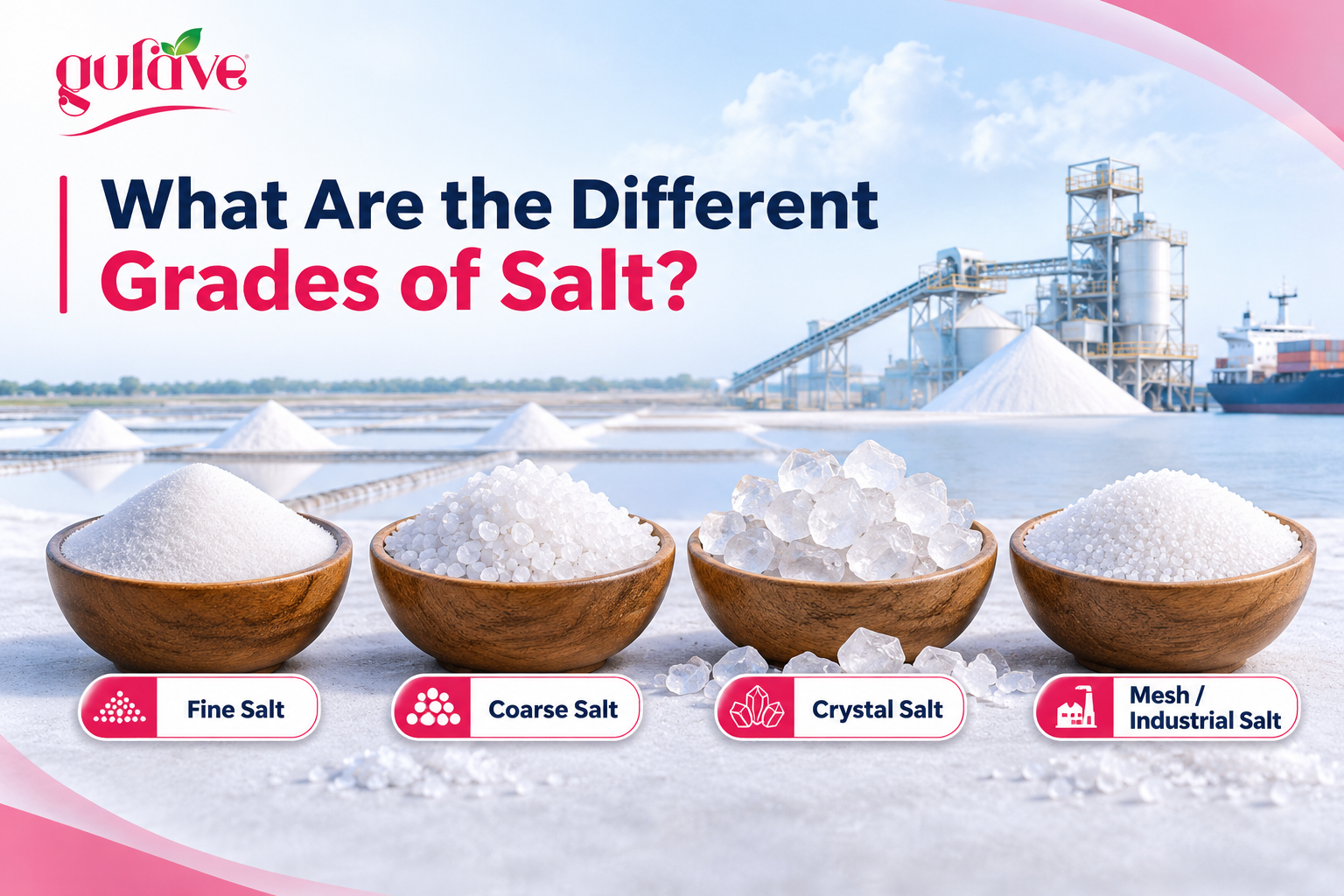
A salt grade is defined by measurable parameters, not by its product name.
| Parameter | Why it matters | What to check |
| Sodium chloride (NaCl) | Purity | % on dry basis |
| Moisture | Caking, storage, weight paid for | % by weight |
| Calcium and magnesium | Scaling, dye spotting, brine treatment cost | Key for textiles and chemicals |
| Insoluble matter | Residue and equipment blockage | % by weight |
| Particle size | Handling and dissolving speed | Mesh or sieve analysis |
| Iodine | Legal requirement for edible salt | ppm against FSSAI limits |
For chemical industries, BIS IS 797:2023 sets two grades: Grade 1 with at least 99.5% sodium chloride and Grade 2 with at least 98.5%. Grade 1 also has tighter limits on calcium, magnesium and insoluble matter.
Coarse, Fine and Mesh Salt
Particle size is a grade in its own right. Coarse salt has large crystals for brine making, de-icing and chlor-alkali feed. Fine salt dissolves quickly and blends evenly, so detergent and food plants prefer it. Mesh salt is screened to a set size range, such as 30 mesh, so it flows consistently through hoppers and dosing machines. On automated lines, ask for a sieve analysis rather than relying on the words “fine” or “coarse”.
Which Salt Is Best for Different Industries?
| Industry | Recommended salt | Key specification |
| Textile dyeing | Low-hardness industrial salt | Low calcium and magnesium |
| Chlor-alkali and chemicals | Industrial salt meeting IS 797 | High NaCl, low hardness and insolubles |
| Detergents | Fine industrial salt | Uniform particle size |
| Food processing | Refined, free-flow iodised or PDV salt | FSSAI compliance and iodine |
| Water treatment | Water softener salt or tablets | High purity, low insolubles |
| Oil and gas | Drilling-grade salt | Bulk supply, consistent particle size |
In reactive dyeing of cotton, salt works as an electrolyte that pushes dye from the bath onto the fibre, so calcium and magnesium directly affect shade consistency. Chlor-alkali plants use salt as the raw material for brine, and every bit of hardness or insoluble matter adds purification cost before electrolysis.
How to Choose the Right Salt Grade and Supplier
- Identify your application. Each end use needs different specifications.
- Request a Certificate of Analysis (COA). Check sodium chloride, moisture, hardness, insolubles and particle size for every batch.
- Check packaging options. Choose from consumer packs, 25 kg or 50 kg bags, containers or bulk vessel shipments.
- Evaluate supply reliability. Confirm capacity and delivery schedules for repeat orders.
- Compare delivered costs. Add freight, storage, handling and any processing losses.
A consistent grade often costs less overall than a cheaper salt that needs extra treatment.
Why Choose Gurave Salt?
Gurave Salt (Shree Krishna & Co) is a salt manufacturer and exporter based in Kutch and Gandhidham, Gujarat, established in 2011. Its range covers industrial, edible, refined, raw, crystal, PDV and water softener salt, supplied in consumer packs, 25–50 kg bags, private-label packaging or bulk vessel shipments to buyers across Asia, Africa and the Gulf.
Businesses researching salt manufacturers in Gujarat can contact Gurave Salt for grades, specifications and export pricing.
Frequently Asked Questions
Which salt is used in textile dyeing?
Low-hardness industrial salt. Its low calcium and magnesium content helps reactive dyes fix evenly on cotton and reduces rework.
What is the difference between refined and free-flow salt?
Refined salt is purified to raise sodium chloride content and whiteness. Free-flow salt contains an anti-caking agent so it doesn’t clump. A salt can be both.
Is iodised salt mandatory in India?
Yes. Common salt sold for direct human consumption must be iodised. Industrial salt does not need iodine.
What is PDV salt?
PDV (Pure Dried Vacuum) salt is high-purity salt made by evaporating purified brine under vacuum. Its uniform crystals suit food, chemical and pharmaceutical processing.
What should a salt Certificate of Analysis include?
Sodium chloride on a dry basis, moisture, calcium, magnesium, insoluble matter and particle size. Reports for edible salt should also show iodine content.
Which Indian state produces the most salt?
Gujarat. It produced about 85.6% of India’s salt in 2021–22, according to the Indian Bureau of Mines.