Salt may look like a simple ingredient, but its quality, purity and particle size can make a significant difference in food production, commercial kitchens and industrial manufacturing. Different applications require specific characteristics, which is why understanding how salt is processed matters when selecting the right product.
Refined salt is processed to reduce naturally occurring impurities and produce a cleaner, more consistent sodium chloride product. It is commonly available in different grades, including double refined and triple refined varieties, with specifications tailored to different applications.
Understanding the manufacturing process, available types and quality factors helps buyers select salt that meets their operational needs without paying for unnecessary specifications.
What Is Refined Salt?
Refined salt is sodium chloride that has undergone cleaning and processing to reduce unwanted minerals, insoluble materials and other impurities found in raw salt.
Raw salt may contain varying amounts of calcium, magnesium, moisture and naturally occurring particles. Refining helps improve its cleanliness, appearance and consistency.
Depending on the production method and intended application, refined salt may offer:
- Higher sodium chloride purity
- Reduced insoluble impurities
- More uniform crystal or grain size
- Controlled moisture levels
- Improved handling and storage characteristics
- Consistent quality for manufacturing
However, not all refined products have identical specifications. Purity, moisture, particle size and additives may vary between manufacturers and grades.
For commercial buyers, reviewing the product specification is more reliable than selecting salt based on appearance alone.
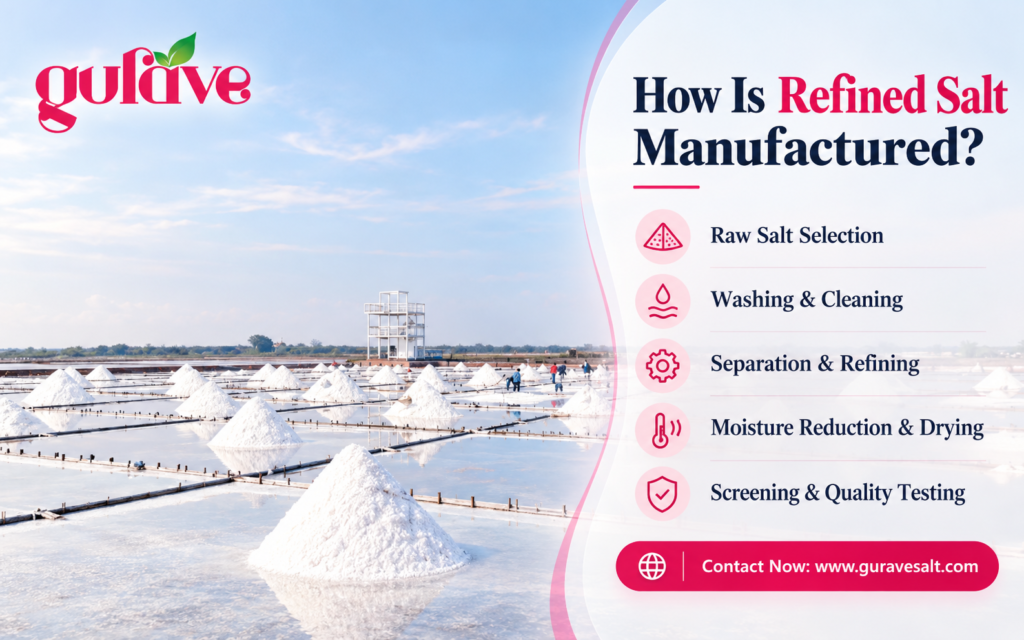
How Is Refined Salt Manufactured?
Salt refining involves several controlled stages designed to improve product quality. The exact manufacturing process depends on the salt source, available equipment and required final specifications.
1. Raw Salt Selection
The process begins with selecting suitable raw salt, commonly obtained through seawater evaporation or other salt production methods.
Manufacturers examine the raw material for factors such as sodium chloride content, moisture and visible impurities.
The quality of the starting material can influence the amount of processing required.
2. Washing and Cleaning
Raw salt may undergo washing with a controlled brine solution to remove surface impurities and unwanted particles.
This stage can help reduce dirt, insoluble matter and certain soluble impurities.
The effectiveness of washing depends on the equipment, brine conditions and processing method.
3. Separation and Refining
Further processing may involve mechanical separation, additional washing or other purification techniques.
These operations help achieve the required quality and particle-size characteristics.
Different manufacturers may use different refining sequences, so the number of processing stages should not be treated as a universal measure of purity.
4. Moisture Reduction and Drying
Excess moisture can make salt difficult to handle and increase the likelihood of lump formation during storage.
Where required, drying equipment reduces moisture to the specified level.
Appropriate moisture control supports packaging, transportation and consistent product handling.
5. Screening and Quality Testing
The processed salt may be screened to obtain the required particle-size range.
Quality checks can include:
- Sodium chloride percentage
- Moisture content
- Calcium and magnesium levels
- Water-insoluble matter
- Grain-size distribution
- Iodine or additive content, where applicable
Once the product meets its specification, it is packaged for domestic distribution or export.
What Are the Different Types of Refined Salt?
Refined salt is available in different processing grades and formulations. Double refined and triple refined products are two commonly marketed varieties.
Double Refined Salt
Double refined salt generally refers to salt processed through a manufacturer’s two-stage refining system.
The objective is to reduce impurities and improve consistency compared with the untreated raw material.
Depending on its verified specification, double refined salt may be suitable for:
- Household cooking
- Commercial food preparation
- Bakery manufacturing
- Snack production
- Pickling and food processing
Buyers should confirm sodium chloride purity, moisture, particle size and food-grade compliance before selecting a product.
Triple Refined Salt
Triple refined salt generally refers to salt that undergoes an additional refining stage according to the manufacturer’s process.
Additional processing may help improve impurity control, uniformity or other quality characteristics.
Potential applications include food manufacturing and other processes requiring carefully controlled salt specifications.
However, triple refined salt is not automatically suitable for every high-purity application. Its actual quality must be confirmed through laboratory analysis.
Double Refined vs Triple Refined Salt: Key Differences
The main distinction is the manufacturer’s refining process. However, the terms are not universally standardized, and the number of refining stages alone does not establish the final sodium chloride purity.
| Feature | Double Refined Salt | Triple Refined Salt |
| Processing | Typically two refining stages | Typically three refining stages |
| Purity | Depends on final specification | Depends on final specification |
| Impurity control | Based on processing efficiency | May involve additional purification |
| Particle size | Available in different grades | Available in different grades |
| Applications | Food and suitable industrial uses | Food and suitable specialized uses |
| Selection | Check laboratory specifications | Check laboratory specifications |
When comparing products from refined salt manufacturers in India, buyers should request current technical specifications rather than assuming one grade is always superior.
A well-processed double refined product may meet a particular manufacturer’s requirements just as effectively as a triple refined alternative.
The most appropriate choice depends on the intended application and documented product quality.
What Are the Common Uses of Refined Salt?
Refined salt serves different purposes across household, commercial and industrial environments.
Food Processing and Manufacturing
Food-grade refined salt is commonly used in snacks, sauces, bakery products, dairy processing and packaged foods.
It contributes flavor and may influence preservation, texture and processing performance, depending on the product.

Household and Hospitality
Suitable edible grades are used in everyday cooking, seasoning and commercial food preparation.
Fine and consistent particle sizes can support controlled dispensing and distribution in recipes.
Chemical Manufacturing
Appropriately specified refined salt may be used as a raw material in chemical processes.
Some applications require particularly low levels of calcium, magnesium and other impurities to protect processing equipment or maintain product quality.
Textile Processing
Salt is used in certain textile dyeing processes to influence dye absorption by fabrics.
The required purity and particle size depend on the fabric, dyeing method and equipment.
Water Treatment
Suitable salt grades are used in water-softening systems to regenerate ion-exchange resins.
For these applications, dissolution characteristics, insoluble matter and equipment compatibility are important considerations.
How Do You Choose the Right Refined Salt?
Selecting salt should begin with understanding the application rather than choosing a product based solely on price or refining terminology.
Check the Technical Specifications
Request a product specification sheet showing sodium chloride purity, moisture, insoluble matter and relevant mineral limits.
Where necessary, obtain a recent Certificate of Analysis to confirm batch quality.
Consider Particle Size
Fine salt may dissolve more quickly under comparable conditions, while coarse material may be preferred for particular equipment or handling requirements.
Choose the particle-size range recommended for your process.
Confirm Food-Grade Requirements
Salt intended for human consumption must comply with applicable food safety and regulatory requirements.
Industrial-grade salt should never be assumed suitable for food use simply because it contains a high percentage of sodium chloride.
Review Packaging and Storage
Packaging should protect the product from moisture, contamination and damage.
Consider storage conditions, delivery quantities, bag sizes and any private-labelling requirements.
Evaluate Supplier Reliability
A dependable supplier should communicate product specifications clearly and support consistent ordering, quality documentation and delivery planning.
About Gurave Salt
Gurave Salt, operating under Shree Krishna & Co, is a salt manufacturer and exporter based in Gandhidham, Kutch, Gujarat, India. Established in 2011, the company supplies refined, industrial and edible salt products for domestic and international markets. Its product range includes double refined salt, triple refined salt, iodized salt and non-iodized varieties, with packaging options designed for commercial and bulk buyers. Gurave Salt serves customers across industries including food processing, textiles and chemical manufacturing.
Why Choose Gurave Salt?
Gurave Salt focuses on delivering products suited to specific buyer requirements rather than treating every application as identical. With experience in salt processing, bulk packaging and international shipments, the company supports customers seeking consistent specifications and practical supply arrangements. Its range of grades and packaging options allows businesses to discuss product suitability, order quantities and export requirements with one supplier.
Frequently Asked Questions
1. Is refined salt the same as table salt?
Not always. Table salt is generally a food-grade product that may contain added iodine or anti-caking agents. Refined salt is a broader category that can include edible and industrial products with different specifications.
2. Is triple refined salt always purer than double refined salt?
No. Additional refining may improve certain quality characteristics, but actual purity depends on the manufacturing process and final laboratory results.
3. Does refined salt contain iodine?
Some varieties contain added iodine, while others are non-iodized. Buyers should check the product label and specification to determine its iodine content.
4. How can buyers identify reliable edible salt suppliers?
Experienced edible salt manufacturers should provide clear product specifications, appropriate food safety documentation, suitable packaging and consistent quality information. Buyers should also confirm that the product complies with regulations in the intended market.
5. What matters most when buying refined salt in bulk?
The most important considerations include intended application, purity, moisture, particle size, regulatory suitability, packaging, order quantity and consistency between batches.
Conclusion
Refined salt is used across food production, household applications and numerous manufacturing processes because of its controlled quality and versatile properties.
Although double refined and triple refined salt differ in their processing approaches, the best choice depends on verified specifications rather than the number of refining stages alone.
By comparing purity, moisture, grain size, additives and application requirements, buyers can select an appropriate grade with greater confidence. Working with an experienced manufacturer such as Gurave Salt can also simplify product selection, packaging arrangements and bulk procurement.