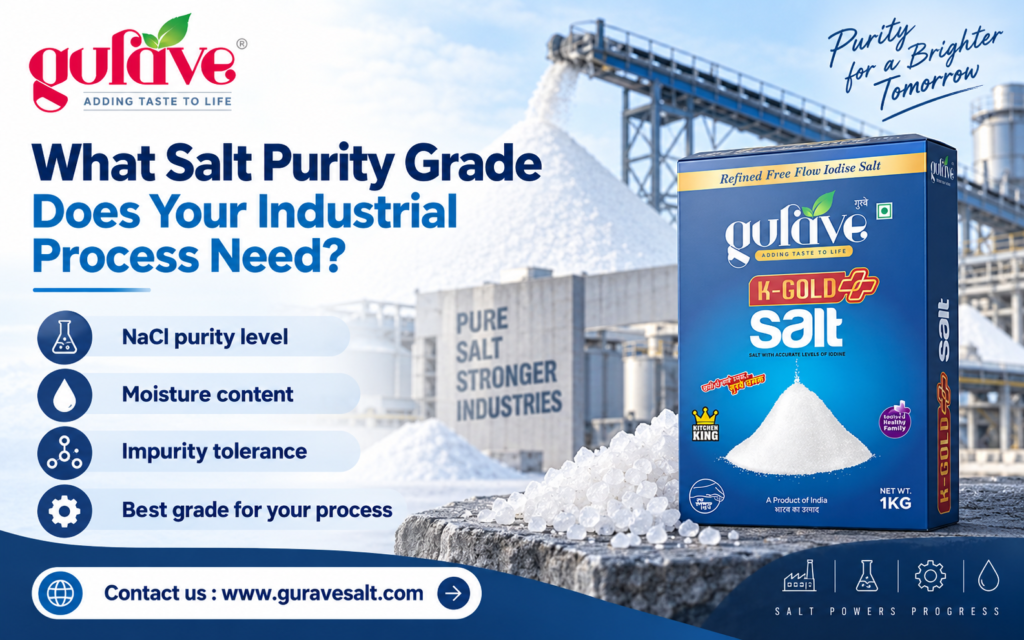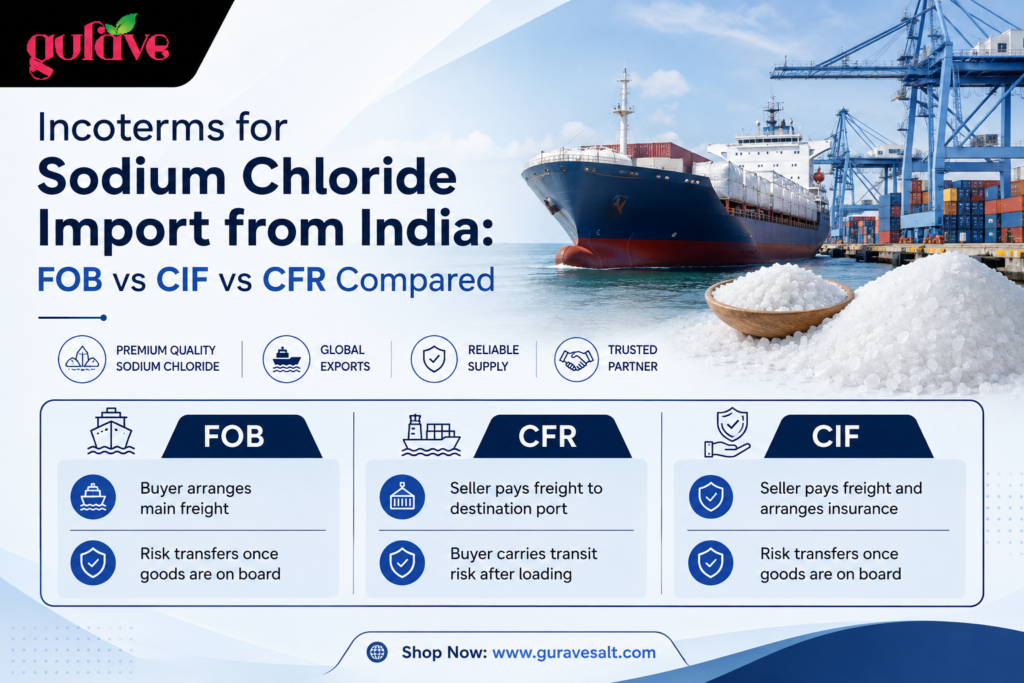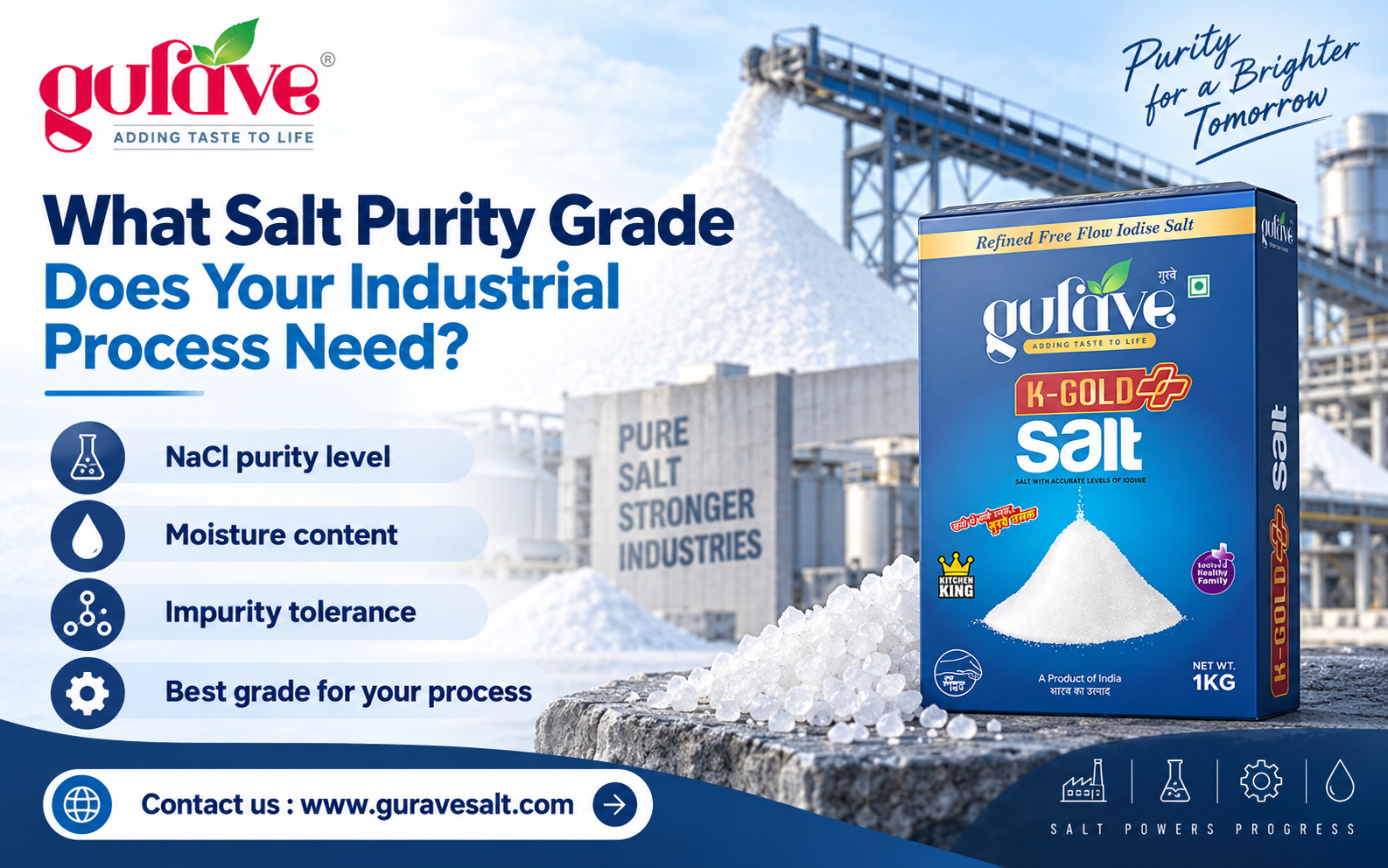
Choosing the right industrial salt is not simply a matter of ordering the product with the highest sodium chloride percentage. The right purity level depends on what the salt will do inside your process, which impurities your system can tolerate, how quickly the salt must dissolve and whether particle size, moisture or hardness can affect production.
For procurement teams, chemical processors, textile manufacturers, water-treatment operators and other industrial buyers, this makes specification matching essential. A grade that performs well in one application may create unnecessary cost or operational problems in another. Instead of asking only, “How pure is the salt?”, buyers should ask, “Which salt specification is suitable for our process?”
Quick Answer: What Purity Grade of Industrial Salt Do You Need?
There is no single purity grade that is ideal for every industrial application.
Your required industrial salt specification should normally be based on:
- Sodium chloride content
- Calcium and magnesium levels
- Sulphate content
- Moisture percentage
- Water-insoluble matter
- Particle or grain size
- Required solubility
- Presence or absence of iodine
- Anti-caking requirements
- Manufacturing process
- Storage and handling conditions
For sensitive chemical or water-treatment processes, tighter specifications may be necessary. For less sensitive bulk applications, a standard industrial grade may provide adequate performance without the additional cost of unnecessary refining.
Why Does Salt Purity Matter in Industrial Processes?
Industrial salt is primarily sodium chloride, but naturally produced salt can also contain moisture, minerals and insoluble materials in varying amounts.
These characteristics can influence how the salt behaves during manufacturing.
For example, excessive insoluble matter can leave residue in systems. High moisture may affect storage and flowability. Calcium and magnesium can matter where hardness-forming minerals interfere with a process. In other applications, consistent particle size may be just as important as chemical purity.
This means purity should be considered as part of the complete specification rather than as a single number.
Higher Purity Is Not Automatically Better
It can be tempting to purchase the highest available grade because it sounds superior. However, that may not always be necessary.
A process that does not require highly refined salt may gain little from paying for additional purification. At the same time, purchasing a lower specification simply because it is cheaper may cause problems if impurities interfere with equipment or production.
The better approach is to match the salt to the technical requirements of the application.
What Should You Check in an Industrial Salt Specification?
Before placing a bulk order, request a current product specification and, where applicable, a Certificate of Analysis.
1. Sodium Chloride Content
NaCl content is one of the first figures buyers normally review.
Different industrial applications require different levels of sodium chloride purity. The appropriate specification should therefore be determined by the process rather than by choosing an arbitrary percentage.
Ask whether the stated purity is typical, minimum or batch-specific.
2. Calcium and Magnesium
Calcium and magnesium are naturally occurring components that may be present in salt.
Their importance depends on the application. In processes where hardness needs to be carefully controlled, buyers may require lower levels of these minerals.
This can be particularly relevant in water-treatment and certain chemical applications.
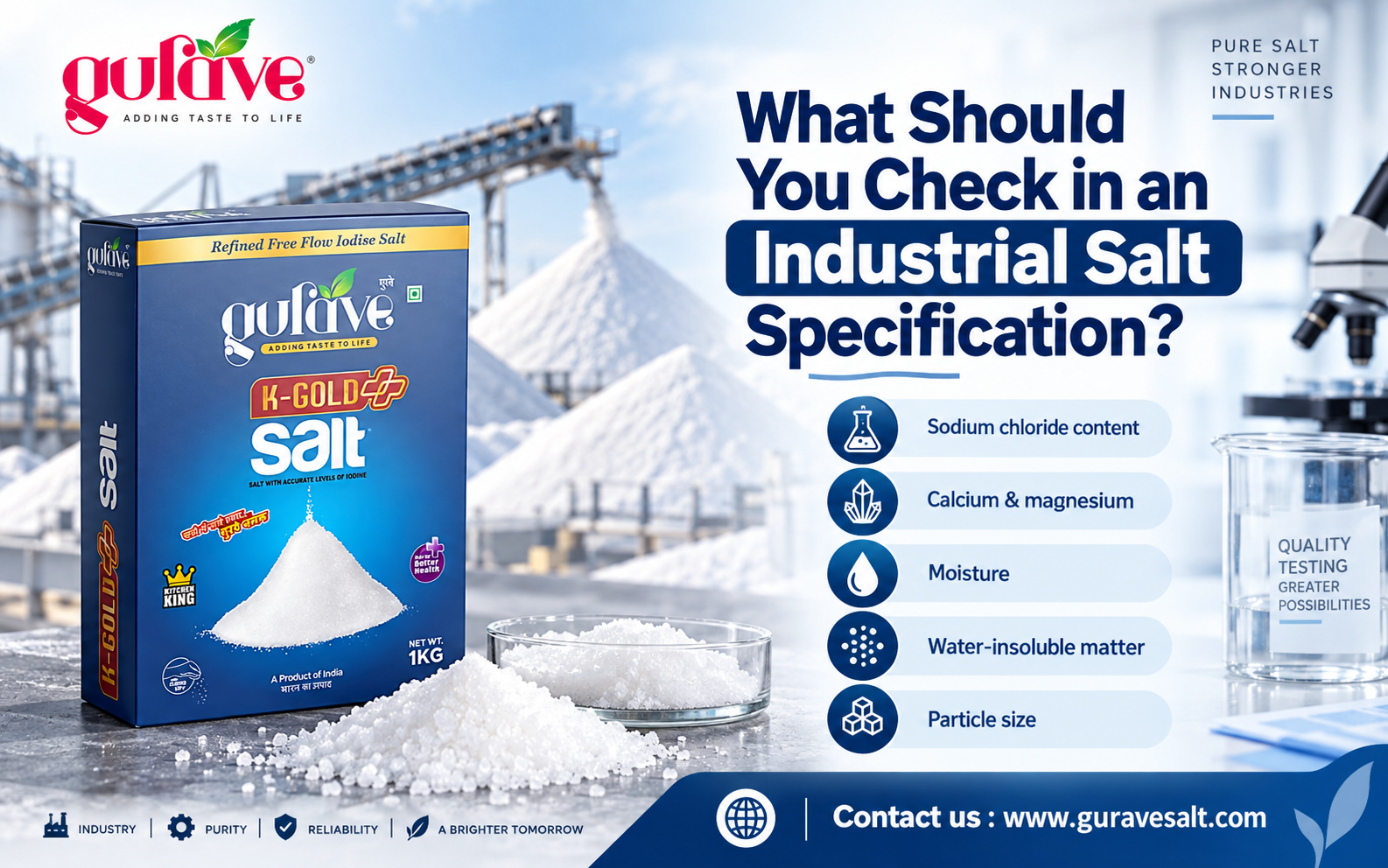
3. Moisture
Moisture influences handling, storage and flow.
Salt with unsuitable moisture characteristics may:
- Form lumps during storage
- Become difficult to discharge from bags or hoppers
- Reduce free-flowing performance
- Create inconsistencies in automated dosing
- Require additional handling before use
Warehousing conditions and packaging should therefore be considered alongside the product’s moisture specification.
4. Water-Insoluble Matter
Some industrial processes require salt to dissolve efficiently.
If the application involves preparing brine, unwanted insoluble material may remain after the sodium chloride dissolves. Depending on the system, this residue may need additional filtration or cleaning.
For this reason, buyers should discuss acceptable insoluble levels with both their technical team and supplier.
5. Particle Size
Purity is only part of the purchasing decision.
Coarse, fine, crushed and specified mesh sizes behave differently during storage, conveying, dissolving and dosing.
A finer particle may dissolve more quickly because of its larger surface area, while a coarser product may be preferred for certain handling or processing requirements.
Consistency is particularly important when salt passes through automated equipment.
Which Salt Characteristics Matter for Different Industries?
Requirements vary considerably by sector.
Chemical Manufacturing
Salt is an important raw material in chemical processing, including applications connected with chlorine, caustic soda and other sodium- or chloride-based products.
Chemical manufacturers may focus on:
- NaCl concentration
- Calcium
- Magnesium
- Sulphates
- Insoluble matter
- Moisture
- Reliable batch consistency
The acceptable limits depend on the plant and production process.
Water Treatment and Softening
Salt used in water-treatment systems should be suitable for preparing or regenerating brine efficiently.
Buyers commonly consider:
- Dissolution performance
- Insoluble material
- Hardness-forming minerals
- Particle consistency
- Clean handling
- Storage stability
Using a suitable grade can help maintain predictable operation and reduce unwanted residues.
Textile and Dyeing Applications
Salt is frequently used during textile processing and dyeing.
Depending on the dyeing system, consistency in salt composition and dissolution can influence process control. Textile buyers should therefore consider chemical specification as well as grain size and supply consistency.
Detergent and Soap Production
Industrial salt may also be used during detergent and soap manufacturing.
The required specification depends on the formulation and production method. Buyers should confirm whether moisture, insoluble or particular minerals can affect the finished product.
Oil and Gas Applications
Salt products may be required in drilling and other oil-and-gas processes where the material performs a specific technical function.
In these cases, procurement should be based on the required technical specification rather than on a general-purpose industrial salt description.
Industrial Salt Is Not the Same as Edible Salt
This distinction is especially important when discussing purity.
Gurave Salt’s previous article, Difference Between Industrial Salt and Edible Salt, explains that edible salt is intended for human consumption and is processed according to food-related requirements, while industrial salt is manufactured for commercial and technical applications.
Industrial purity therefore does not automatically mean food-grade suitability.
A high NaCl percentage alone should never be used to decide whether a product is appropriate for human consumption. Intended use, manufacturing controls, applicable standards and product documentation all matter.
This is an important point for procurement teams sourcing salt for multiple divisions within the same business.
How Should Buyers Compare Industrial Salt Suppliers?
When comparing industrial salt manufacturers in india, avoid making the decision solely on price per tone.
The cheaper quotation may not represent better value if the product does not match your required specification.
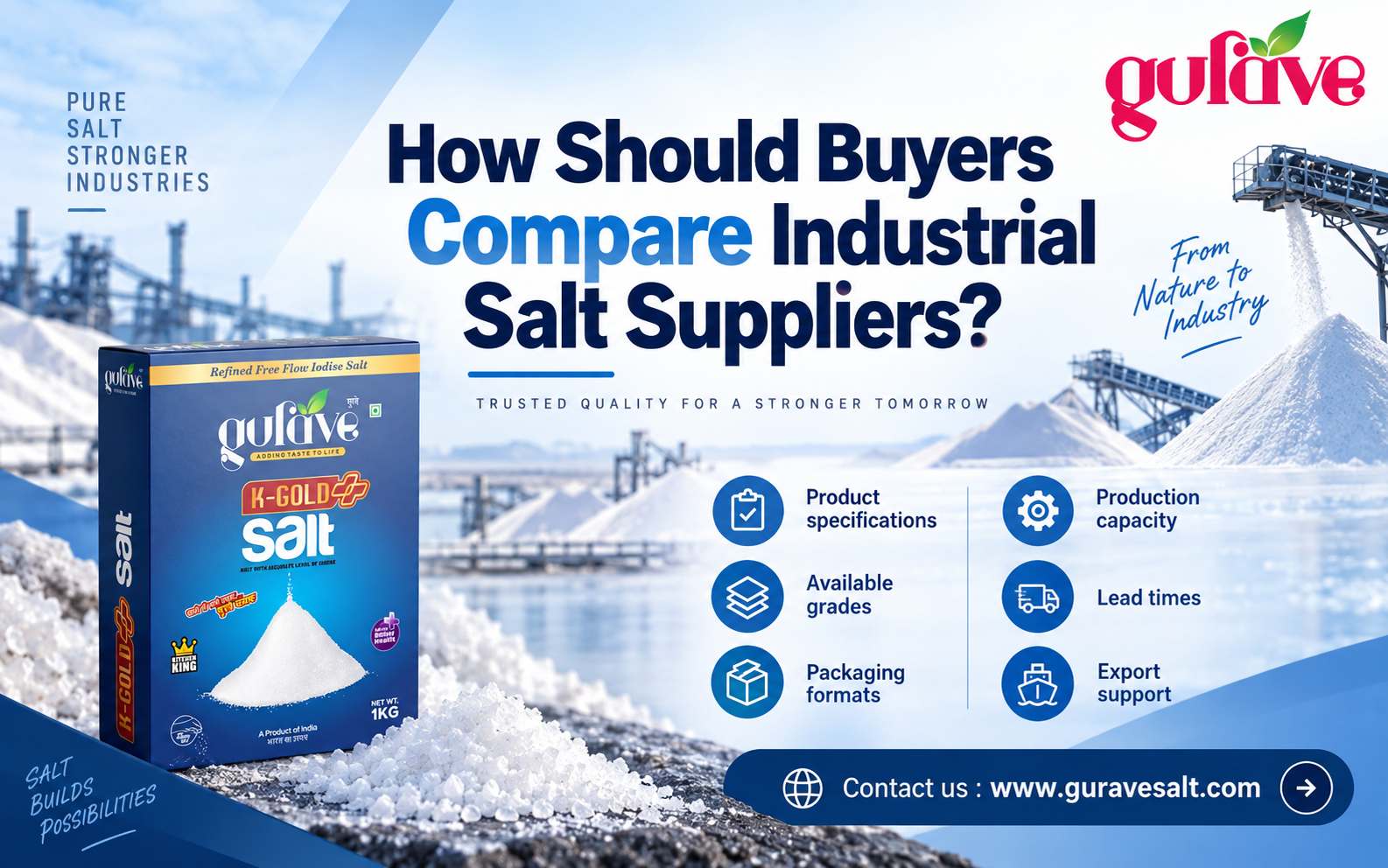
Ask potential suppliers for information covering:
- Product specification
- Typical or batch-specific analysis
- Available grades
- Particle-size options
- Packaging formats
- Minimum order quantities
- Production capacity
- Lead times
- Export capabilities
- Loading arrangements
- Documentation availability
- Consistency across repeat shipments
For long-term contracts, consistency can be particularly important. A specification is useful only if the supplier can maintain it from one shipment to the next.
Should You Ask for a Certificate of Analysis?
For applications where chemical composition is important, a Certificate of Analysis can provide useful batch-level information.
Depending on the product and testing scope, a COA may report values such as sodium chloride, moisture, calcium, magnesium, sulphates or insoluble material.
However, buyers should not assume that every COA includes the same parameters.
Before ordering, compare the supplier’s reported test items with your own procurement specification.
Create Your Own Purchase Specification
Instead of sending an inquiry that says only “We need industrial salt,” provide more detail.
A useful enquiry may include:
- Required NaCl specification
- Maximum moisture level
- Limits for relevant impurities
- Required mesh or particle size
- Monthly or annual quantity
- Bag size
- Palletization requirements
- Destination country or port
- Required certificates or documentation
- Intended industrial application
This helps the manufacturer recommend a more appropriate product and reduces misunderstandings during procurement.
About Gurave Salt
Gurave Salt is a salt manufacturer, supplier and exporter based in Gujarat, India, with operations in the Gandhi Dham and Kutch region. The company supplies industrial salt for applications including chemical manufacturing, textile processing, water treatment, detergent production and other large-scale industrial requirements.
Its industrial range includes products such as coarse salt, refined industrial salt, fine salt, mesh salt, non-iodised salt, water-softener products and other application-specific grades. This range enables buyers to discuss both chemical specifications and physical characteristics according to their intended use.
Why Choose Gurave Salt for Industrial Salt Supply?
A reliable industrial supplier should provide more than a product quotation. Buyers also need dependable specifications, appropriate packaging, supply capability and support when defining their requirements.
Gurave Salt focuses on:
Application-Based Product Selection
Different plants have different requirements. Buyers can discuss their application, purity expectations, particle size and packaging requirements before finalising the grade.
Multiple Industrial Salt Options
Access to different salt formats helps procurement teams select a product based on function rather than relying on a one-grade-fits-all approach.
Bulk Supply Capability
Industrial users often require continuous or high-volume supply. Reliable production and logistics planning are therefore important for reducing procurement disruption.
Export-Oriented Supply
International buyers must consider packaging, loading, documentation and shipment planning alongside product quality.
Quality-Focused Procurement Support
For buyers comparing products from different suppliers, clear specifications and relevant analytical information make technical evaluation easier.
Questions to Ask Before Approving a Salt Grade
Before signing off a new industrial salt source, ask:
- What NaCl specification does our process genuinely require?
- Which impurities can affect our equipment or finished product?
- Do we have maximum limits for moisture or insoluble?
- What particle size works best with our handling system?
- Does the salt need to dissolve at a particular rate?
- Is a product specification sheet available?
- Can a Certificate of Analysis be supplied where required?
- Will specifications remain consistent across repeat orders?
- What packaging protects the salt during storage and shipping?
- Can the supplier support our required volume and delivery schedule?
These questions create a stronger procurement process than simply requesting the “highest purity industrial salt.”
Choosing the Right Industrial Salt Manufacturing Partner
When reviewing industrial salt manufacturing companies in india, begin with your technical requirement and work backwards to the supplier.
Define what your production line needs, identify the characteristics that matter most, establish acceptable limits and then compare available products against those requirements.
For some buyers, sodium chloride purity will be the main consideration. For others, calcium, magnesium, moisture, insoluble, grain size or dissolution behavior may be equally important.
The right supplier should be able to discuss these variables clearly instead of treating every industrial application as identical.
Frequently Asked Questions
What is the best purity level for industrial salt?
There is no universal best purity level. The appropriate specification depends on the intended industrial application, process sensitivity and acceptable impurity limits.
Is higher-purity salt always better for industrial use?
Not necessarily. Higher-purity material may be unnecessary for applications that can tolerate a broader specification. Buyers should choose a grade that meets process requirements without paying for unnecessary refinement.
What impurities should buyers check in industrial salt?
Common parameters may include calcium, magnesium, sulphates, moisture and water-insoluble matter. The important limits vary according to the application.
Does particle size affect industrial salt performance?
Yes. Particle size can influence dissolution speed, flowability, dosing, storage and compatibility with processing equipment.
Should industrial buyers request a COA?
Where chemical composition or batch conformity is important, requesting a Certificate of Analysis can help buyers verify relevant parameters. The required tests should be agreed with the supplier.
Can industrial salt be used as edible salt if the NaCl purity is high?
Not automatically. Industrial and edible salt are produced for different intended uses and requirements. A high sodium chloride percentage does not by itself make an industrial product suitable for human consumption.
Which industries commonly use industrial salt?
Industrial salt is widely used in chemical manufacturing, water treatment, textiles, dyeing, detergent and soap production, leather processing, oil and gas operations and other manufacturing processes.
Conclusion
Choosing an industrial salt grade should start with the needs of your process not with the assumption that the highest purity or lowest price is automatically the right option.
Review sodium chloride content alongside moisture, mineral impurities, insoluble matter, particle size, dissolution requirements and packaging. Then compare those requirements with supplier documentation and production capability.
By defining a clear purchasing specification before requesting quotations, businesses can reduce procurement risk, improve process consistency and select a salt grade that delivers the performance their operation actually requires. Gurave Salt can support industrial buyers seeking application-appropriate salt products for domestic and international supply.