Iodisation is an important quality and regulatory consideration for edible salt sold for human consumption in India. For food processors, wholesalers, retailers and bulk buyers, understanding Food Safety and Standards Authority of India (FSSAI) requirements matters because iodine content can decrease between production and the point at which salt reaches the consumer.
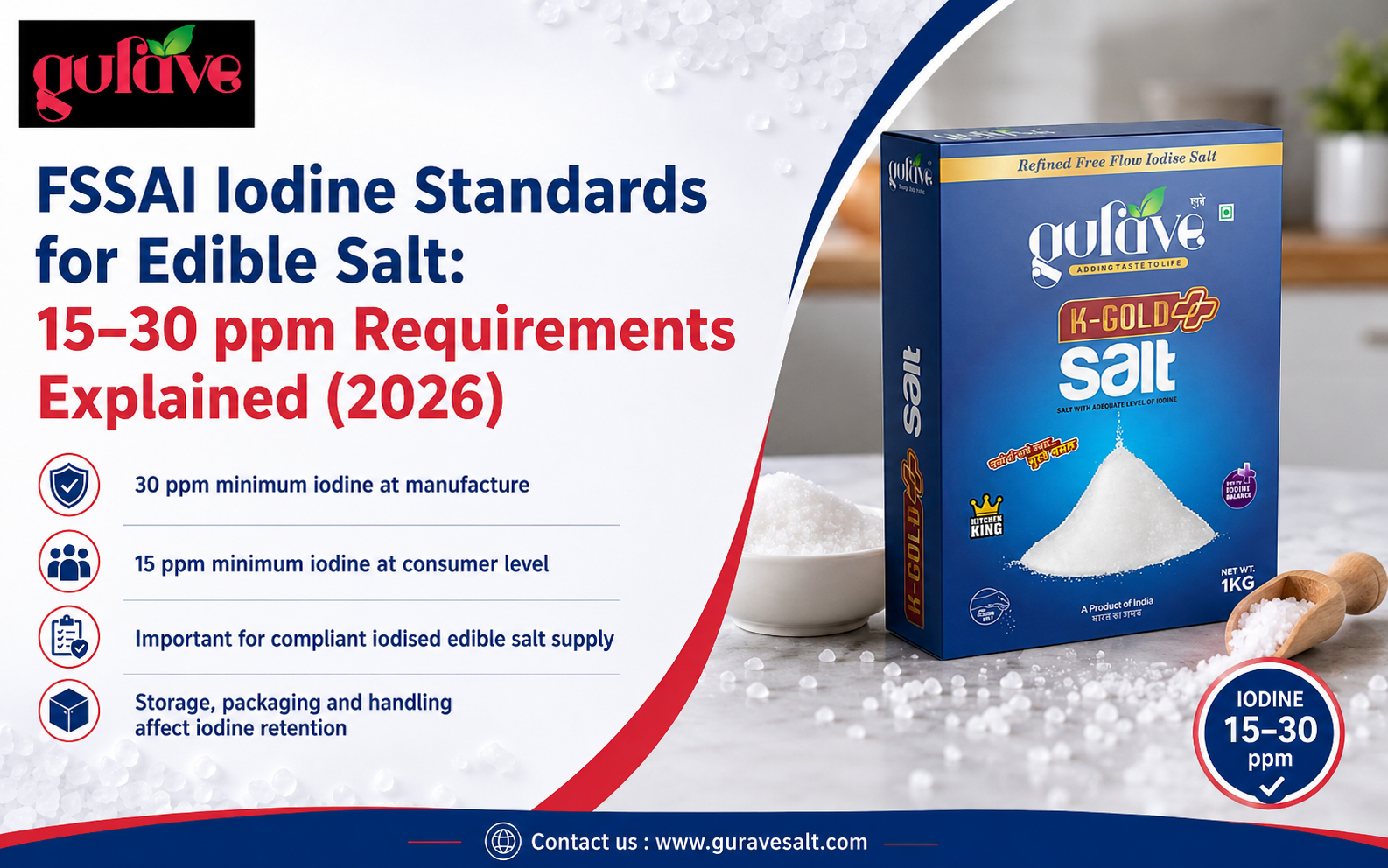
When businesses compare edible salt manufacturers in gujarat, iodine should not be treated as a simple label claim. Buyers should understand how the product is iodised, how the iodine level is controlled during processing, and whether the finished salt is designed to retain adequate iodine through storage and distribution. Current FSSAI guidance identifies minimum iodine levels of 30 parts per million (ppm) at the manufacturing level and 15 ppm at the consumer level.
What Does the FSSAI 15–30 ppm Iodine Requirement Mean?
A common misunderstanding is that FSSAI allows iodised salt to contain any amount between 15 ppm and 30 ppm. That is not the best way to interpret the requirement.
FSSAI guidance identifies minimum iodine levels at two different stages:
- At the manufacturing or production level: iodine should be at least 30 ppm.
- At the consumer level: iodine should be at least 15 ppm.
Therefore, 30 ppm is not simply an upper end of a permitted range, while 15 ppm is not a production target. The two values recognise that iodine can be lost after manufacture because of storage, moisture, packaging, transport and cooking.
This distinction matters for procurement teams. A batch that leaves a factory with an appropriate iodine level needs to remain adequately iodised after moving through the supply chain.
Why Is the Manufacturing-Level Requirement Higher?
Iodine is added to common edible salt because salt is widely consumed and provides a practical vehicle for micronutrient fortification. However, iodine is not completely stable under every condition.
FSSAI food-fortification guidance notes that some iodine can be lost during distribution, storage and cooking. A higher production-level minimum therefore provides a margin so the salt can still retain the required iodine level when it reaches consumers.
Factors That Can Affect Iodine Retention
Several practical conditions may influence iodine retention:
- Exposure to humidity or moisture
- Poorly sealed or damaged packaging
- Long storage periods
- High storage or transport temperatures
- Direct exposure to sunlight
- Unsuitable warehouse conditions
Manufacturers and buyers therefore need to think beyond the initial laboratory result. Packaging, warehousing and distribution practices can contribute to maintaining product quality.
What Does 30 ppm Mean at the Manufacturing Level?
Thirty ppm means 30 parts of iodine per one million parts of salt on the applicable measurement basis. For manufacturers, the important point is that iodised salt must meet the production-stage requirement when it is manufactured and released into the supply chain.
Uniform fortification is also important. If iodine is not distributed consistently through the batch, separate samples can produce different results. Controlled dosing, blending, sampling and quality checks support more reliable production.
Bulk buyers should ask suppliers how iodine is incorporated and how batch consistency is monitored rather than relying only on a general product description.
What Does 15 ppm at the Consumer Level Mean?
The 15 ppm figure is the minimum level expected at the consumer stage. It reflects the possibility that some iodine may be lost after salt leaves the factory. FSSAI specifically identifies 30 ppm at manufacture and 15 ppm at consumer level as minimum iodine levels.
For distributors and food businesses, proper storage can therefore matter. Dry conditions, intact packaging and suitable stock rotation can help protect the product between receipt and use.
The practical lesson is simple: compliance should be considered across the product’s journey, not only at the point of manufacture.
Why Free-Flow Iodised Salt Needs Careful Process Control
For buyers sourcing from free flow salt manufacturers in gujarat, iodine is only one part of the specification. Free-flow salt is also expected to pour consistently and maintain suitable physical characteristics during storage and handling.
The manufacturing process must therefore manage iodisation alongside refining, drying, blending and any permitted anti-caking treatment. Consistency is particularly important for food factories using salt in measured formulations, where variations in moisture, granulation or iodine distribution can complicate production control.
What Bulk Buyers Should Request From a Supplier
Before approving an edible salt supplier, procurement teams can request:
- Product specification sheet
- Batch-wise Certificate of Analysis where applicable
- Iodine test result and test method
- Sodium chloride purity
- Moisture level
- Packaging type and pack size
- Manufacturing and batch details
- Storage recommendations
- Applicable food-safety or quality certifications
The exact documents needed can vary according to the buyer’s industry, destination market and quality system.
Testing Iodine in Edible Salt
Simple salt-testing kits can indicate whether iodine is present, but they are not a substitute for quantitative laboratory analysis when an exact ppm result is required. FSSAI guidance explains that salt testing kits can be used to detect iodine, while determining actual iodine content requires appropriate analysis.
For commercial quality assurance, buyers should review both the result and the testing method. A specification value is more useful when the buyer knows whether it is a minimum, target, typical value or actual batch result.
Storage and Packaging Practices That Help Protect Iodine
After purchase, buyers also have a role in protecting iodised salt. Bags should be kept in a clean, dry area away from excessive moisture and direct sunlight. Damaged packs should be separated, and stock should be rotated through a suitable first-in, first-out system.
For consumer packs, secure sealing and suitable moisture protection are important during distribution. For industrial packs, warehouse conditions and handling practices become equally relevant.
FSSAI Compliance Is Broader Than Iodine Alone
Iodine concentration is important, but it should not be the only parameter considered when purchasing edible salt. FSSAI product standards cover edible common salt, while other food-safety rules can apply to areas such as labelling, packaging, licensing and contaminants. FSSAI also states that common salt intended for sale is subject to mandatory iodisation requirements, while certain other salt categories can be treated differently under the regulations.
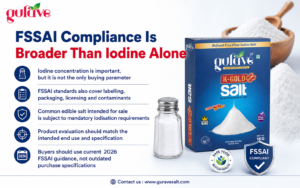
Businesses should therefore evaluate the supplier and product against the complete specification required for the intended use. Requirements for ordinary iodised edible salt may also differ from specialised salts or double-fortified salt.
For 2026 procurement, buyers should work from current FSSAI regulations and official guidance applicable to the exact product category rather than relying on an old specification copied from an earlier purchase contract.
Why Choose Gurave Salt?
Gurave Salt, operating as Shree Krishna & Co, is a Gujarat-based salt manufacturer and exporter established in 2011. Its published range includes edible, refined and free-flow iodised salts, along with consumer and bulk packaging options for domestic and export requirements. Businesses evaluating iodised salt manufacturers in india can consider Gurave Salt for bulk supply, multiple packing formats and export-focused salt sourcing. Buyers should confirm their required iodine specification, packaging, documentation and destination-market requirements when requesting a quotation.
Conclusion
The FSSAI figures of 30 ppm and 15 ppm are best understood as stage-specific minimum iodine requirements, not as a simple 15–30 ppm acceptable range. The higher manufacturing-level minimum allows for iodine losses that may occur before consumption, while the consumer-level minimum helps ensure salt remains adequately iodised at the point of use. For bulk buyers, combining regulatory awareness with supplier qualification, batch testing, suitable packaging and controlled storage can support consistent quality and stronger compliance across the edible salt supply chain.