Every bulk salt shipment should arrive with a document that tells you exactly what is inside the bag. That document is the Certificate of Analysis the COA. It is the single most important piece of paper in a salt procurement decision, and it is also the one most buyers skim past.
A COA is not a marketing brochure. It is a batch-specific laboratory report stating measured values for purity, moisture, insoluble matter, and mineral content. When a supplier says “99.9% pure,” the COA is where that claim either holds up or falls apart. If you are sourcing from Triple Refined Salt Manufacturers in Gujarat or evaluating any bulk sodium chloride vendor, learning to read this document properly is the difference between a stable supply chain and a costly rejection at your plant gate.
This guide walks through every line on a salt COA, what each value should be for different grades, and the red flags that should stop an approval.
What Is a Salt Certificate of Analysis?
A COA is a laboratory-issued document confirming that a specific production batch meets defined specifications. It is tied to a batch or lot number, not to the supplier in general.
That distinction matters enormously. A supplier can hold every certification in the world and still ship you an out-of-spec batch. The COA is your proof for this consignment.
A complete salt COA contains:
- Batch or lot number — traceable to a specific production run
- Date of manufacture and date of analysis
- Product grade and description — refined, double refined, triple refined, PDV, raw
- Test parameters with measured values — not just pass/fail
- Specification limits for each parameter
- Test method references — the standard used for each test
- Laboratory details and authorized signatory
- Packaging and quantity covered by the certificate
If any of these are missing, you are holding a partial document.
The Core Parameters: What Every Line Means
Sodium Chloride Content (NaCl %)
This is the headline number the percentage of the product that is actually sodium chloride. Everything else is water, minerals, or insoluble matter.
Typical ranges by grade:
- Raw / crystal salt — 96.0% to 98.0% NaCl (dry basis)
- Refined salt — 98.5% to 99.0%
- Double refined salt — 99.0% to 99.5%
- Triple refined salt — 99.5% and above
- PDV (pure dried vacuum) salt — 99.7% to 99.9%
Critical detail buyers miss: NaCl% is usually reported on a dry basis. A batch showing 99.5% NaCl at 3% moisture is not the same as 99.5% at 0.05% moisture. Always check which basis is stated. If the COA does not specify, ask.
Moisture Content (%)
Moisture drives caking, weight loss in transit, and flow problems in your dosing equipment. It also means you are paying for water.
- Raw salt — 2.5% to 4.0% is normal for solar-harvested product
- Refined free-flow salt — below 0.5%
- PDV salt — below 0.1%, often 0.03% to 0.05%
Higher moisture in a refined grade is a processing failure, not a natural variation.
Matter Insoluble in Water (%)
Insoluble are sand, clay, and mineral debris that will not dissolve. In brine systems, water treatment, and textile dyeing, insoluble clog filters, foul nozzles, and leave residue on fabric.
- Raw salt — up to 0.5% may be acceptable depending on application
- Refined grades — below 0.05%
- PDV — below 0.01%
For any dissolving application, this number matters more than NaCl% does. A 99.5% salt with 0.3% insoluble will cause more downstream trouble than a 99.0% salt with 0.02% insoluble.
Calcium (Ca) and Magnesium (Mg)
These are the hardness ions. They cause scaling in boilers, interfere with reactive dyeing, and produce off-taste and hygroscopicity in food salt.
Reported either as ppm or as calcium/magnesium compounds:
- Ca — refined grades typically below 0.1%; low-hardness grades below 0.04%
- Mg — refined grades typically below 0.05%; low-hardness grades below 0.02%
Magnesium is the more aggressive of the two for caking, because magnesium chloride is strongly hygroscopic. If your salt turns to a brick in storage, check the Mg number first.
Sulphate (SO₄)
Sulphate is a residue from the mother liquor in solar production. It affects dye fixation and can contribute to scale.
- Refined grades — typically below 0.4%
- Higher-purity grades — below 0.2%
Iodine Content (ppm)
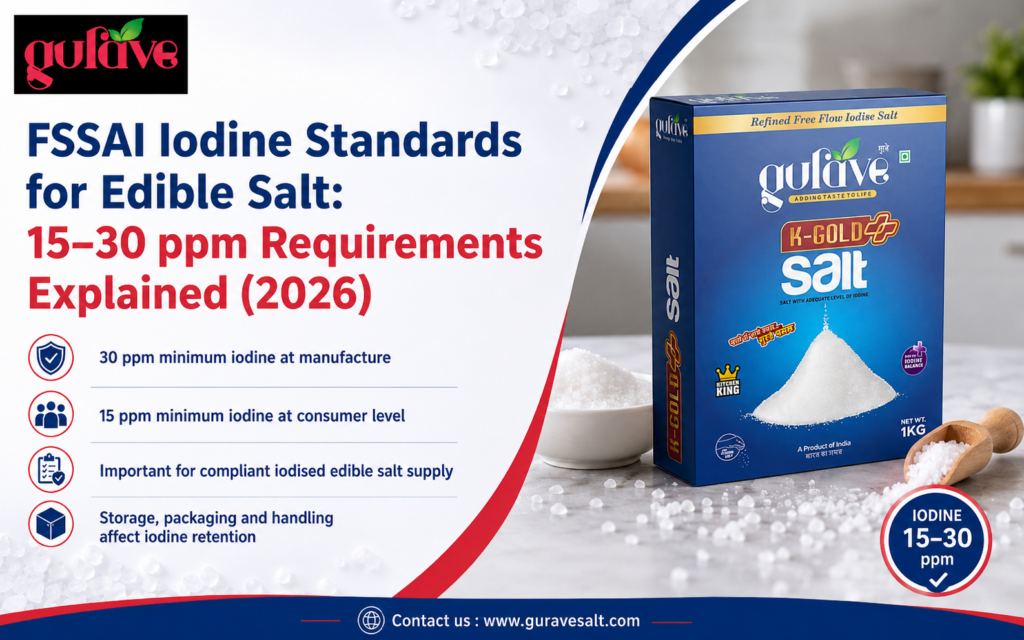
Only relevant for iodized edible grades. Reported as ppm of iodine, and the number must be read alongside the stage at which it was measured — iodine values decline over shelf life, so a manufacturing-stage figure and a consumer-stage figure are different targets.
If your COA gives an iodine number without stating the stage of measurement, it is incomplete.
pH
Usually measured on a 10% or 5% solution. Neutral salt sits between 6.5 and 8.5. Values outside that range suggest contamination or residual processing chemicals.
Test Methods: The Line Nobody Reads
A value without a method is not a result it is an assertion.
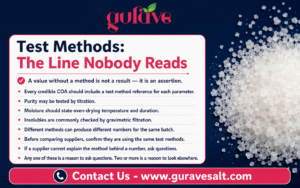
Every parameter on a credible COA carries a method reference. Purity by titration, moisture by oven-drying at a stated temperature and duration, insoluble by gravimetric filtration. Two laboratories using different methods can produce different numbers for the same batch.
When comparing quotes from two suppliers, confirm they are testing the same way before you conclude one product is better. A supplier who cannot tell you the method behind a number either is not testing or is not testing themselves.
Any one of these is a reason to ask questions. Two or more is a reason to look elsewhere.
Matching the COA to Your Application
The best grade is not the purest grade it is the grade whose spec matches your process.
| Application | Priority parameters |
| Boiler / water softening | Ca, Mg, insoluble |
| Textile reactive dyeing | Ca, Mg, SO₄, insoluble |
| Chlor-alkali / chemical | NaCl%, Ca, Mg, SO₄ |
| Food processing | NaCl%, moisture, insoluble, iodine |
| Pharmaceutical | NaCl%, heavy metals, microbiology |
| Oilfield drilling | NaCl%, moisture, particle size |
If you are running a chlor-alkali cell, calcium at 0.15% will cost you membrane life regardless of a headline 99.5% NaCl figure. Buyers approaching a PDV Salt exporter for pharmaceutical or high-purity chemical duty should be reading the trace-metal and insoluble lines before they look at price those are the parameters that determine whether the product works in the process.
Overpaying for purity you do not need is a real cost. So is buying a grade that fails in your line.
How to Build a COA Review Process
Reading one COA well is useful. Reviewing every COA consistently is what actually protects you.
- Define your own spec sheet first — before you request quotes, write down your acceptable range for each parameter. Do not let a supplier’s spec sheet become your standard by default.
- Request COAs for three recent batches during vendor evaluation, not just one. Consistency across batches is the real signal.
- Ask for a pre-shipment sample with its matching COA and test it yourself or through a third party.
- Compare arrival COA to pre-shipment COA on your first two or three orders.
- Third-party verification — SGS, Bureau Veritas, or Intertek for critical or first-time consignments.
- File every COA against its batch number — when a problem surfaces six months later, this is your only trace back.
- Re-audit annually — approved suppliers drift.
About Gurave Salt
GURAVE SALT (Shree Krishna & Co) is a salt manufacturer and exporter based in Gandhidham, Kutch, Gujarat, established in 2011. Operating from India’s principal salt-producing belt, the company supplies both edible and industrial sodium chloride to buyers across Asia, Africa, and the Gulf. Annual capacity runs to 200,000 MT of raw and industrial salt through bulk vessel shipments and 35,000 MT of refined and edible salt in bagged and containerized form, with a monthly supply ability of 3,000 to 5,000 MT. The product range spans crystal and raw salt, refined and free-flow iodized salt, triple refined salt, PDV, low-hardness, mesh, textile, detergent, and drilling grades marketed under the K-Gold, K-Fresh, and K-Premium brands.
Why Choose Gurave Salt
For buyers who have worked through this guide and want a supplier who can actually answer the questions it raises:
- Documented export track record — first shipment in 2011, with ongoing supply to China, UAE, Oman, DRC, Kenya, Bangladesh, Sri Lanka, and Malaysia
- Proven bulk vessel capability — including consignments of 52,000 MT (MV Glovis Melody) and 51,000 MT (MV APJ Jad)
- Port access — Mundra, Kandla, and Tuticorin, supporting both bulk vessel and container shipments
- Batch-level quality documentation — certificates available on request against specific consignments
- Flexible packaging — 200g and 1kg consumer packs through 25kg, 35kg, and 50kg bags to loose bulk, with private-label options
- Defined lead times — 15 to 20 days from order confirmation, subject to volume and customization
- 50+ trained staff across production, quality, and logistics
Whether you require food-grade iodized salt, high-purity vacuum-dried product, or bulk industrial grades, Gurave Salt supplies against specification with the documentation to support it. Buyers sourcing from established Sodium Chloride manufacturers in Gujarat should expect nothing less than a batch-traceable COA with every consignment and should be prepared to walk away from any vendor who cannot produce one.
The Bottom Line
A COA is your only objective view into a product you have not yet received. Read it line by line. Check the basis, check the method, check the batch number, check the date. Compare against the spec your process actually needs not the spec the supplier chose to lead with.
Suppliers who test properly are glad to be asked about it. The ones who hesitate have told you what you needed to know.
To request a specification sheet or a batch-specific certificate of analysis for any grade, contact the Gurave Salt team at mail@gurave.co or +91 9727575492.